Precision use cases provide a hands-on way for customers to implement key Precision feature scenario.
 How does Precision help when there is an impact on QoE?
Precision helps you with the decision making at a granular level. Precision has the ability to move only the impacted traffic that affects QoE in individual video delivery paths using a Video AI Platform.
Precision processes the industry-trusted QoE intelligence collected by VSI to automatically drive multi-CDN optimization at a granular level to improve service resilience, viewer experience, and cost effectiveness of delivery.
Precision is capable of detecting congested network paths and best performing CDNs in each region. Precision can also route around origin failures and congestion if multiple origins are used.
Precision works through an API so the critical path of delivery is never impacted. As Conviva's customer, you control the mechanism of CDN switching and Conviva provides the intelligence into your CDN selector.
Example: Seamless re-distribution of traffic between CDNs during an outage
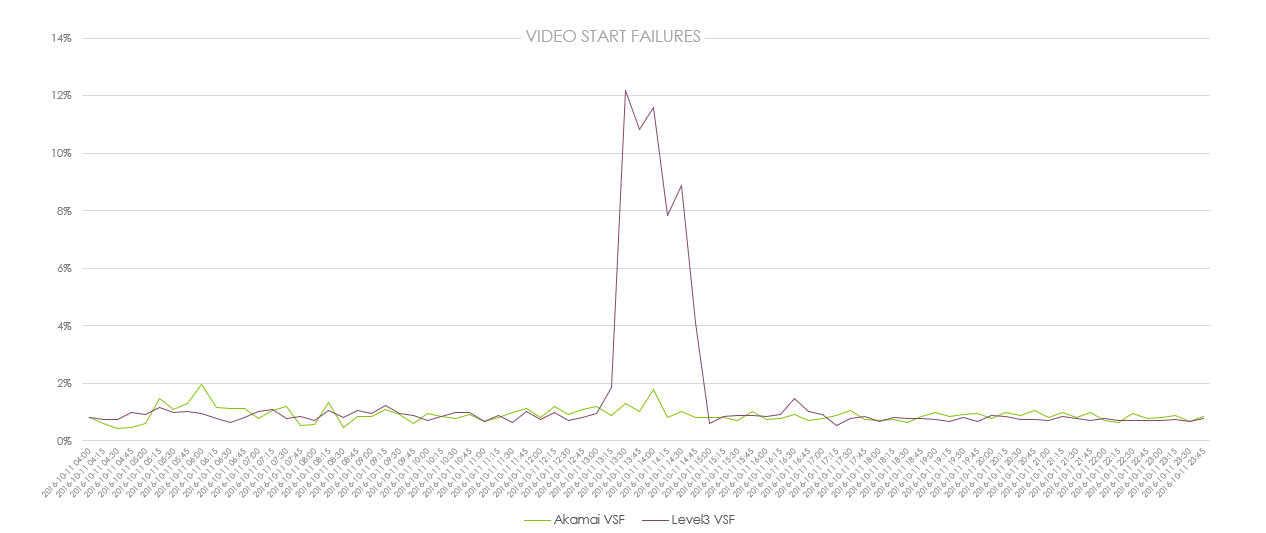
The following graph displays the distribution of traffic between two CDNs without Precision during an outage. As shown in the graph, there is no re-distrubution of traffic between the CDNs despite the outage due to VSF errors in Level 3.
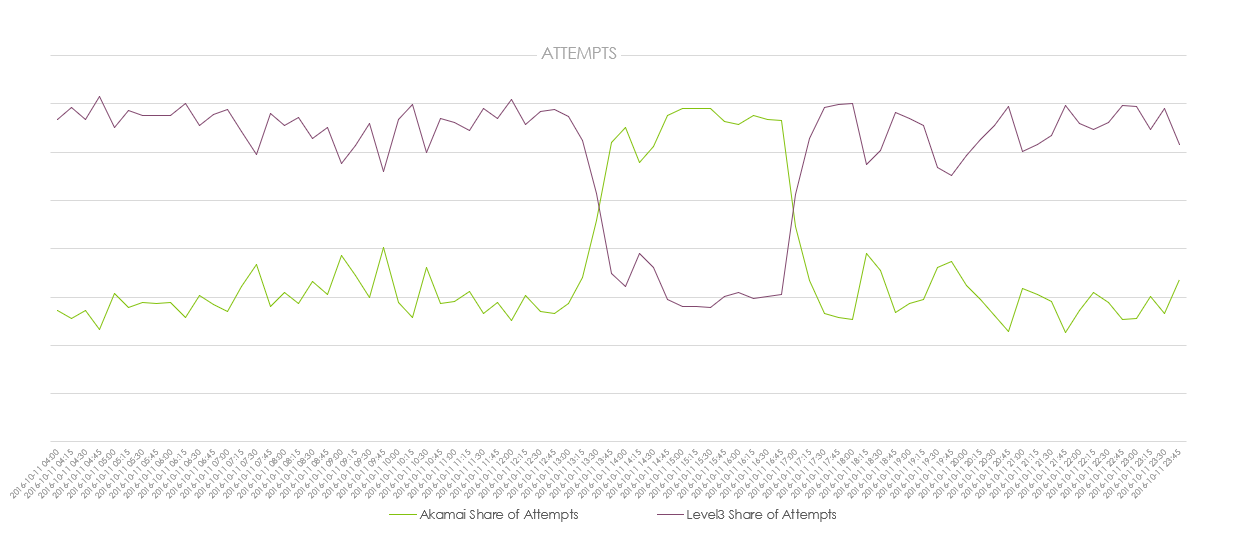
The following graph displays the distribution of traffic between two CDNs with Precision during the same outage. As shown in the graph, there is seamless re-distribution of traffic between the CDNs when there is an outage due to VSF in Level 3 and when the outage is resolved.
How to combine CDN and multiple origin as resources to load-balance traffic and avoid origin issues?
Using a combination of CDN configuration and Precision policies, you can set up multiple origin and CDN mappings to load balance traffic across CDNs and switch origins to avoid origin issues.
-
Set up your CDN URLs and origins to enable multiple origin and CDN mappings.
-
Contact Conviva Support to create the Precision policies with the CDN URLs and resource name for the origins, for example CF-A, for CloudFront CDN using origin A.
-
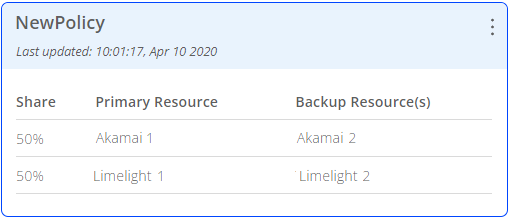
Use the Precision policy settings to manage the order of policies and percentage of traffic allocation.
It's common to use a 50/50 traffic allocation across CDNs with backup policies based on different origins.
Should you introduce a higher bitrate stream for increased picture fidelity?
If this is a point that you are considering, and given the extra costs involved in encoding, origin, and CDNs, coming to a conclusion requires a justified business driver.
The questions related to this dilemma that we usually encounter from other customers are:
-
What is the industry trend on Average Bitrates for similar types of service, content, and devices? How does this trend evolve over time and what is my competition doing?
-
How can I calculate the ROI and justify the costs? More importantly, will this result in higher viewer engagement and more subscribers?
Regarding the industry trend on Average Bitrates and competition analysis, we use Experience Benchmarks which provides you with insight and intelligence related to streaming performance about your peers.
Regarding calculating the ROI and related questions, you can implement A/B group testing. Using this technique, you can compare the results in terms of QoE and engagement on each group.
For A/B viewer testing, you create two groups:
-
Group A are viewers who are assigned a higher bitrate stream.
-
Group B are viewers who are assigned a lower bitrate stream.
Using Precision you can allocate the streams to groups A and B consistently. It also automatically ties with Conviva VSI so you can confirm the QoE KPIs for each group of viewers and the respective Viewer Engagement. Precision assures that you have a meaningful engagement test, where the bitrates allocated for the two groups are consistent (a viewer's bitrate stream cannot fluctuate). Using VSI, you can evaluate the results in terms of QoE and Engagement for each group. You can also leverage advanced analytics reporting capabilities to determine the statistical significance of the results.